I've already done other projects involving remotely operating kerbal space program. It's relatively simple to pull data from the simulation and to send commands back to it.The question I wanted to answer was what commands did I need to send in order to send a rocket into orbit without touching the controls once, and how I can optimize the flight trajectory. What I wanted to find was a function that could take a rockets current telemetry and output the controls the rocket should make to continue on an optimal flight path.
I knew that this function was going to be complicated, so I didnt really care about what it looked like. All I wanted was a black box that I could feed the inputs and it would spit out an output. This is the definition of a problem that deep learning and machine learning is suppose to solve.
I had set up a model to train itself and hopefully learn how to fly. In reality all it did was find more optimal ways to crash into the ground. This was made slower by the fact that KSP has a memory leak in its saveloading, meaning that every run the code did, KSP would get more and more unstable until in corrupted something. This put a hard limit on the amount of runs I could let he script run for before manually restarting everything. After about 200 hours of training and pains, I admitted that this wasn't working and I should do something else.
Rocket guidance is really hard to find good papers on (for good reason I guess). It is nice when a paper from the 1960's says that OLS can be used and provides functions that are polynomials of degree 2 at most. This just told me to take the input parameters (and my input parameters squared) and run OLS on them to get the required outputs.
It really was that easy. The OLS took data points from 4 launches with manual control (about 2000 data points) and in total took about an hour to get the run shown above. There's still work to be done with optimization now. The OLS mimic'd how I flew the craft, but its not the most optimal way to get into orbit. Up next I would take the weights recieved from OLS, and start tweaking them up and down by small amounts in hopes to get a more optimal output. Optimization was determined by the amount of fuel left over in the craft after achieving orbit.
Small tweaks were done after in a similar vein to simulated annealing work I had done previously. With that it only required another 20 hours to run and get something that is more efficient than any manually control launch.
Aircraft autopilot really isnt that hard (dont quote me on that, edge cases exist and I've seen them). It mostly involves finding what direction you should point at and turn to point that way.
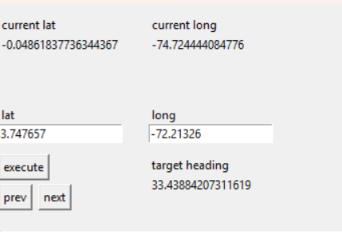
A GUI was built to help with changing variables in real time to help with debugging. Dealing with coordinates tends to be in degrees, while all computations need to be converted into radians naturally. A lot of bugs involved finding where this convertion was not described.
Turns were applied by rolling up to 30 degrees. A semi-complex collision detection method was installed where it would check the ground clearance up to 5 minutes ahead of its current direction. If a tolerance was no met, it would attempt to pitch up while canceling any current turn commands. This still had bugs and liked to crash into cliffs, but overall was able to service its requirements.